
As Nepal’s flood recovery continues, it’s time to talk about Australia’s accountability to South Asia
Two weeks since the devastating floods in Nepal and Tibet, the recovery effort continues, with more than 5,000 people still unaccounted for, including 35 Australians.

Beyond humanitarian payments, however, Nepal is now raising the stakes on culpability around this disaster and calling for climate justice from top carbon emitters and wealthy countries. This call for accountability sits squarely on Australia’s shoulders.
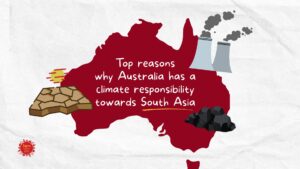
As one of the world’s largest fossil fuel exporters, and home to more than 1.3 million South-Asian born residents, Australia has an unmistakable climate obligation to South Asia.
Nepal, for instance, contributes no more than 0.1 per cent of global emissions and is amongst the world’s least developed countries (LDCs). The mountain country has estimated the cost of rebuilding after these recent floods at US$ 5 billion, or about a tenth of its GDP.
This brings us to Australia: responsible for 4.5% of global fossil fuel emissions, our carbon footprint is disproportionately huge compared to our population or economy. But when it comes to climate finance, Australia is still one of the lowest contributors amongst developed countries, according to an Oxfam analysis.

This must change. Put simply, Australia has climate finance and climate reparation obligations towards South Asia because the well-being and future of our regions and people are inextricably bound together.
- Firstly, the size of Australia’s South Asian population—at least one in 24 Australian residents were born in South Asia, and even more likely have South Asian ancestry—indicates strong kinship ties and financial links to South Asia, in the form of taxes paid by these migrants here and remittances sent back to support their communities. A quarter of Nepal’s GDP, for example, is made up of remittances sent from overseas. Australia’s rapidly growing Nepalese community that sent an estimated US466.6 million in 2021 is one of the major contributors of these remittances that support Nepal’s economy and households.
- Second, Australian trade and relationships with South Asia are deepening. From the security and defence relationships strengthened by Prime Ministers Albanese and Modi on the latter’s recent visit to Australia, to NSW Premier Chris Minn’s just-completed trade mission to India, it is clear that South Asia’s economic and geopolitical stability matter to Australia.
- Third, Australia is high on the list of wealthy countries that have long considered the Himalayas their playground. According to the Nepal Tourism Board, Australians were the sixth-largest visitor group to Nepal in 2023. The fact that 35 Australians remain missing in Nepal is a painful reminder of how intertwined our tragedies and triumphs are.
The Australian government cannot evade its international climate obligations to South Asia any longer. The region’s diaspora in Australia is doing much of the heavy lifting in supporting their communities back home by remitting money for longer-tem recovery and rebuilding after disasters, but this is not enough.

The decision by the International Court of Justice (ICJ) in 2025 confirmed that states are bound by international law to prevent climate harm and protect present and future generations. Australia was among the nations that endorsed the United Nation’s General Assembly adoption of this resolution, and now must abide by it.
Speaking at the United Nations General Assembly later this month, the Nepalese Prime Minister is expected to raise the stakes on climate justice. At the upcoming COP31 conference in Türkiye this November, Australia must make new climate finance pledges to fill funds for adaptation, and loss and damage. From the Pacific to South Asia, the world will be watching.
There is no time to lose. The climate time bomb is ticking in South Asia. Mountain countries like Nepal in the climate-vulnerable Himalayas to downstream countries like low-lying Bangladesh through which many Himalayan rivers flow into the Bay of Bengal, are test cases for climate justice.

The way in which big polluters and wealthy nations respond to Nepal’s call for climate compensation will shape how we survive, without moral injury, on a planet where many of the communities that have done nothing to contribute to the problem are bearing the heaviest burden.
Australia fancies itself as the land of the fair go. Living out this value on the global stage means that Australia must accept its accountability to South Asia by stepping up its climate finance commitments and acting on climate change by urgently ending the expansion of coal, oil, and gas.
Written by Ruchira Talukdar
Come to our upcoming online information session to find out how migrant remittances are helping fill the gap in climate finance, and why countries like Australia have a responsibility to support vulnerable countries like Nepal.
Leave a comment